- Home
- Faculties
- Faculty of Health and Life Sciences
- Our departments
- Department of Psychology
- Psychology sustainability
Psychology sustainability
In Psychology, we are committed to supporting and advancing environmental sustainability in our teaching and research. We strive to give all students and staff opportunities to take part in activities supporting environmental sustainability, and we encourage our students to think about sustainability in their course.
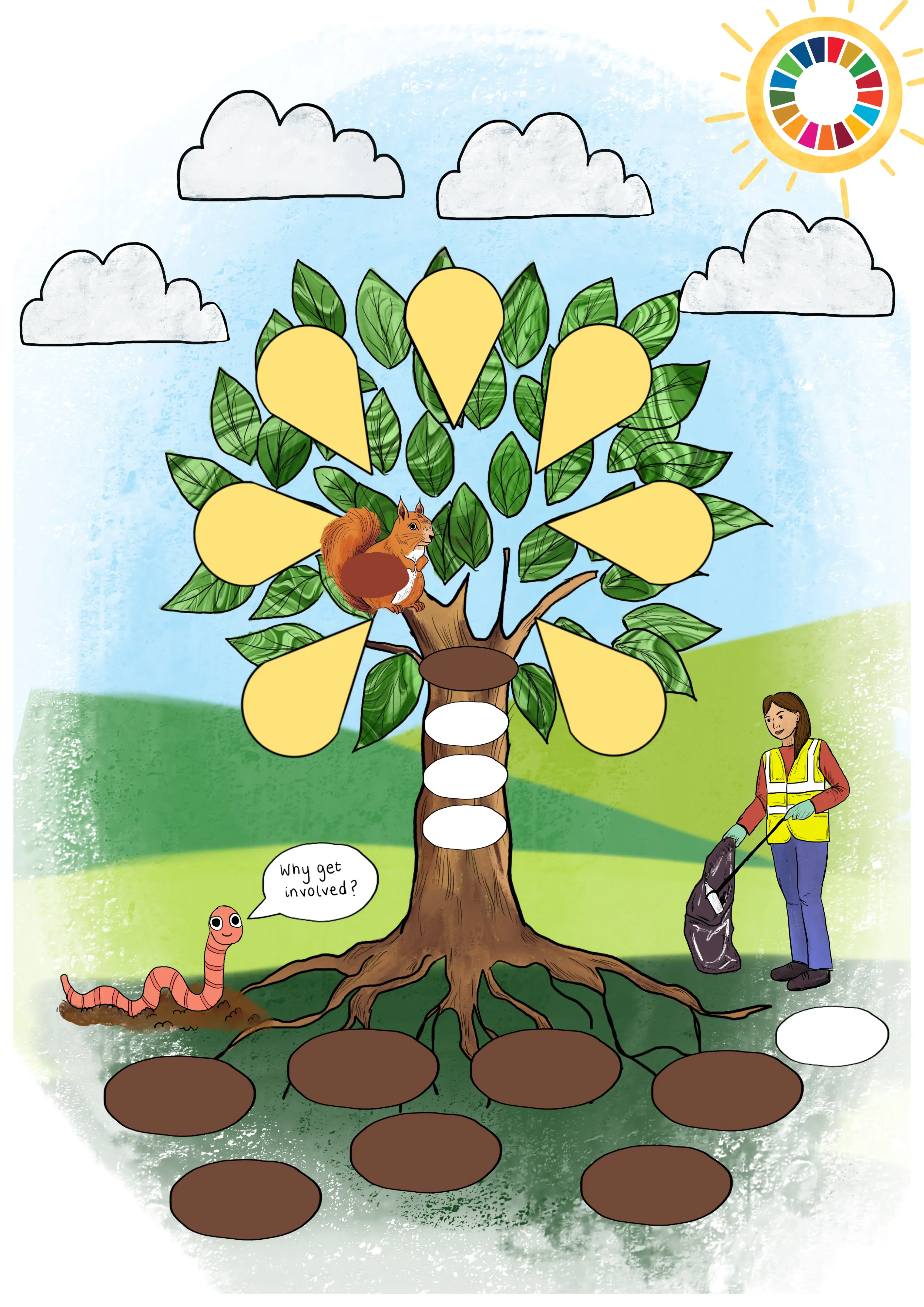
Please explore our tree below (by clicking on the words) to learn more about how sustainability is embedded in teaching and research in Psychology.
Optional
Modules
Optional
Modules
Optional
Modules
Projects
& Guild
Actions
relevance
responsibility
Eco-anxiety
mental health
modules
opportunities
SDGS
1st Year Optional Modules
PSY1105 - Introduction to Behaviour and Evolution
This module explores how and why animals behave in the way they do, as well as gain insight into human and animal behaviour and evolution. Spanning ethology, sociobiology, and behavioural ecology, it offers practical applications of animal behaviour in conservation, welfare and research, human evolution, sexual selection, and human psychology.
In this module students can pursue work experience and develop employability skills. Work experience could take an environmental or sustainability focus if the student wishes.
2nd Year Optional Modules
PSY2214 – Observations and experiments in animal behaviour
Explores how to pose and answer scientific questions by making observations and carrying out experiments, focusing on animal behaviour. Includes observational investigations and experiments in both the laboratory and field (largely on the University campus), teaching skills that could be useful for studying biodiversity and conservation.
PSY2216 – Qualitative Methods and Interview skills
Introduces you to the world of qualitative research where you have words, rather than numbers as data. The topic of the practical report is drawn from environmental psychology. You get access to original interview data exploring university students’ experiences of eco anxiety (worries or concerns related to the climate crisis). You learn how to analyse and make sense of this data using thematic analysis.
3rd Year Optional Modules
PSY3455 Environmental Psychology
Environmental psychology explores varied questions including the psychology of pro-environmental behaviours and how spending time in nature can impact wellbeing and mental health.
PSY3458 The Psychology of Inequality, Conflict and Social Change
Psychology occupies a unique position in that it provides the theories, methods, and analytical tools needed to. understand, predict, and influence individual and collective behaviour, making it central to advancing environmental sustainability at both personal and societal levels.
We examine the neural and psychological mechanisms underlying why people lose control over their behaviour in disorders ranging from OCD and substance use to the more recently proposed behavioural “addictions” (e.g. gambling, over-eating, gaming, social media, and unsustainable consumption). The module considers mechanisms and interventions for environmentally unsustainable behaviours such as excessive shopping and meat consumption.
PSY3464 The Psychology of human-animal intergroup relations
Humans have a unique relationship with animals. Some of them (e.g., dogs) we love as family members. Others (e.g., pigs) are used as objects for food. We examine the psychological tensions underlying why people care for some animals while consuming others. Drawing on developmental and social psychological research, students explore how early childhood empathy towards animals can coexist, and later conflict, with adult dietary practices that involve both caring for and eating animals.
Dissertation Projects
3rd Year Dissertations
Sustainable education in Psychology - PSY3401 (Final Year Psychology Research Project)
Towards the end of their 2nd year, psychology students select and rank six dissertation topics. Some of these focus on sustainability:
Climate change and biodiversity
This topic explores how psychological, physiological, and social factors shape human and non-human animal responses to climate change and biodiversity loss. It includes research on climate communication, activism, and how environmental concerns influence behaviours like diet, family planning, and product choices, or research on how wild and captive animals can adapt to changes in climate and impacts on biodiversity, for example in space use, foraging or nest building. It also considers how neurodiversity, gender, and political views affect sustainable action.
Environmental psychology
Explores the relationships people have with their environments, whether those be built, social, natural or virtual – how we interact and engage with our surroundings, how we influence and change our environments, as well as how our environments impact upon us. It explores how and why certain people engage in pro-environmental behaviours (e.g., around eating/energy use/travel). We also explore environmental natural disasters and human-made traumas, assessing their role in climate anxiety and related mental health issues.
Behaviour Change Interventions for Sustainable and Healthy Eating
Examines dietary behaviour change at the intersection of human health and environmental sustainability, with a focus on understanding and shifting food-related decision-making. Typical projects involve the design and evaluation of interventions such as cognitive training to modify food preferences, participation-based initiatives like Veganuary, and structural changes to the food environment that make healthier and more sustainable choices easier and more accessible.
Sustainable education in Psychology - PSY3401 (Final Year Psychology Research Project).
Extra-curricular modules
Grand Challenges
Grand Challenges is an award-winning on-campus project week in which you work in interdisciplinary groups with other like-minded students and staff to design innovative solutions to real world challenges like climate change, food security, inequality, and health. It emphasises real-world problem-solving, systems thinking, and co-creation with external partners to develop practical, socially relevant solutions.
Sustainable education in Psychology - Grand Challenges
Green consultants
Green Consultants is an award-winning programme designed to provide students with additional skills and experience required to work in the highly competitive environmental and sustainability sector. The training includes online learning that you can start at any time, after which the Green Consultants team will write you a LinkedIn recommendation outlining your activities. If you wish, you can then take part in a group project (30 hours) and apply for a paid internship. All parts of the programme can be used to contribute to the Exeter Award.
Futures 17
Futures 17 is a fully online module, which as a psychology student you can apply for as a non-credit bearing module and receive a certificate from QS on successful completion. It empowers students to collaborate globally on real-world sustainability challenges, developing innovative solutions aligned with the UN SDG’s.
Societies & Guild
Be the change
Be the change are a society campaigning for sustainability in Exeter. They provide a supportive space for students to tackle issues they are passionate about, with a focus on environmentalism.
Personal Actions
There are simple changes that students and staff at Exeter are taking to live more sustainability and reduce their carbon footprint. On this page you can explore more about food and drink, wasting less, and second-hand fashion, as well as opportunities to volunteer and get involved in sustainability initiatives..
Build community
"By studying what drives environmentally harmful behaviours, psychology can help design interventions to promote sustainable actions (e.g., reducing carbon footprints, recycling)."
BSc Undergraduate student
Inter-disciplinarity
“As climate change will affect everyone worldwide, therefore we should be engaged with sustainability in all fields.”
BSc Undergraduate student
Real world relevance
"As climate change and environmental change start to affect populations more and more in daily life, these impacts will ultimately also affect mental health and psychological stability in those around us. Psychologists will need to be trained and prepared to deal with the effects on mental health of damage climate change causes."
“I think there are elements that are taught in psychology that could link nicely to climate change and raising awareness of it. I think it’s important to raise awareness for it as well as making psychology more relevant to today's issues.”
BSc Undergraduate student
Everyone’s responsibility
“Climate change is something that affects us all and will affect our future, so we should be involved in it”
BSc Undergraduate student
Change behaviour
“Psychology should absolutely engage with sustainability and climate change. Behavioural Change is Key to Sustainability. Climate change isn’t just a scientific or political issue - it’s fundamentally about human behaviour. Psychological research helps us understand why people make environmentally harmful choices and how to encourage sustainable behaviours.”
BSc Undergraduate student
Reduce eco-anxiety
“I believe being engaged with sustainability and climate change is something that should happen in psychology due to the significant psychological impacts environmental issues have on us. Research has shown that climate change contributes to rising levels of anxiety and stress. As psychology is about the study on human behaviour, by researching climate change we can develop interventions to support mental health and wellbeing and direct behavioural change.”
“Climate change can cause a lot of anxiety so having the option to be engaged and informed can help reduce the anxiety felt and therefore, will help people's psychological state and reduce the impacts of the anxiety in other areas of their life.”
BSc Undergraduate student
Nature and mental health
“Nature is very important to our mental health, so it is important for people learning about psychology to understand/ experience this."
BSc Undergraduate student
Volunteering
Exeter Student Volunteers (ESV) are a people focused society, which aims to improve the lives of those in need. It provides the opportunity to get involved in a range of projects including those relating to food action and environmental issues. This article from Sarah a previous Welfare Officer at Exeter Student Volunteers provides helpful tips for getting started with volunteering and activism at university.
Core modules
“3rd year”
Core third year modules are general and may include some content related to sustainability, e.g., in PSY3403 - Contemporary Issues in Psychology
The third year dissertation and optional modules offer dedicated opportunities to explore psychology related to sustainability in depth (see tree ‘petals’ on the 3rd year dissertation and 3rd year optional modules for more information)
“2nd year”
PSY2205- Personality and Individual Differences
Examines current and historical understanding of personality and individual differences, and situates theories within a sustainability context by examining how stable traits, values, and motivations shape human behaviour in relation to environmental responsibility, social equity, and long-term societal wellbeing.
“1st year”
PSY1204 - Introduction to Clinical Psychology
Provides insight into the work of a clinical psychologist and the range of conditions they help to treat. It includes a practical session exploring climate anxiety and the intersection between climate change and mental health.
Seminars
For seminars related to sustainability at the University of Exeter, please search:
Staff research
Research in Psychology related to Climate Adaptation and Environmentally Sustainable Behaviour is themed around health and climate change; biodiversity and human–nature relationships; communications and social movements; and pro-environmental behaviour.
More information is in the short video and on our website.
UN SDGs
Learn more about the SDG’s
The Sustainable Development Goals (SDGs) are 17 interlinked global goals adopted by all United Nations Member States in 2015 to address poverty, inequality, environmental degradation, peace, and prosperity by 2030 (United Nations General Assembly, 2015). Staff are encouraged to add relevant SDGs to their module ELE pages to support the University of Exeter’s commitment to embedding the SDGs in education and research. .
Resources and ideas for how to include sustainability in your psychology teaching and supervision.
Transformative education design principles
The Transformative Education Framework aims to use the power of education to transform students’ lives so that they, in turn, can transform the world. Sustainability is one key area of transformative education. Explore the staff SharePoint and resources here.
Teaching psychology for sustainability
A collaborative online resource, offering syllabi, student activities, lecture materials and multimedia to help educators integrate behaviour-based sustainability into psychology courses. Visit TeachGreenPsych Site
1 in 5 project
The ‘1 in 5 project’ is a place where staff can collaborate; sharing ideas for the supervision of final year research projects/dissertations that involve sustainability, climate change and or biodiversity. Explore examples of past psychology 1 in 5 projects here.
SDG’s – Sustainable development goals for modules.
The Sustainable Development Goals (SDGs) are 17 interlinked global goals adopted by all United Nations Member States in 2015 to address poverty, inequality, environmental degradation, peace, and prosperity by 2030 (United Nations General Assembly, 2015). Staff are encouraged to add relevant SDGs to their module ELE pages to support the University of Exeter’s commitment to embedding the SDGs in education and research (https://www.exeter.ac.uk/about/sdgs/)
Jobs and graduate opportunities
Career development for sustainability/Career zone University of Exeter
A fantastic resource from the career zone to allow you to learn more about sustainability, in addition to ways to get involved, gain experience and explore job opportunities and industries for sustainability.
Environmental and Social Governance (ESG)
Environmental and Social Governance (ESG) refers to how organisations manage their impact on, and identify risks and opportunities related to, the environment, wider society and governance issue.
Why get involved
Why students think it’s important to engage with sustainability in Psychology
We asked more than 100 of our psychology students why sustainability is important. The roots below show some of their comments, which touch on:
1) Psychological health is intrinsically linked to planetary health;
2) Psychology is well placed to provide solutions to aiding sustainability;
3) Sustainability it important for everyone and Psychology is no exception.
See video summary:
Staff echoed students’ comments about the importance of embedding sustainability in teaching psychology:
Field trips
PSY2217 – Wild Behaviour
This residential practical module explores what methods we can deploy to explore why humans and other animals behave as they do in natural settings. The field course for this module is designed to be sustainable, low-carbon, and accessible. Students travel by coach to a residential education centre in South Wales, where they learn about native wildlife through hands-on fieldwork, working collaboratively with peers and staff to support inclusive, experiential learning